Meeting Challenges and Forging Opportunity in Cognitive Warfare
We previously noted that a central challenge of cognitive warfare is governing the relationship between institutional cognition and an operational environment in which informational, behavioral, and social dynamics evolve continuously and often independently of military decision timelines. To meet this challenge, we propose that future command architectures should emphasize and integrate mechanisms for the adaptive synchronization of human judgment, AI, and the cognitive ecosystem being engaged. This approach augments extant theories of command by recognizing that operational advantage emerges from maintaining temporal alignment between institutional decision-making and the environment in which decisions are executed and incur effects.
Human-AI Teaming for Temporal Synchronization
One method of constructing such an architecture is to reconsider the roles of humans and AI across the decision cycle. If a temporal gap arises because human-paced observation, decision, and execution cannot keep pace with an environment that continues to evolve in the interim, the relevant question becomes which functions must remain human and which can be delegated to AI systems better capable of synchronizing with the cognitive environment. This reframing shifts the challenge from one of tempo alone to one of function reallocation. We posit that the resulting approach entrusts speed-bound functions to AI systems operating under human direction while preserving human judgment, accountability, situational interpretation, and responsibility.
Figure 2
Reallocation of Human and Machine Function across the Decision Cycle
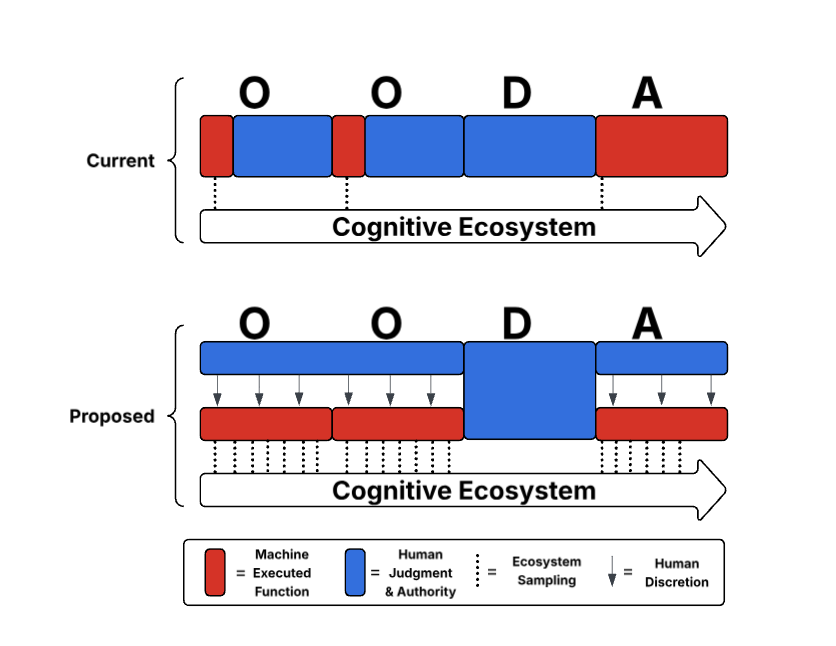
Note. This figure consists of two panels depicting a decision cycle along a left-to-right temporal axis. Red segments denote machine-executed functions and blue segments denote human judgment and authority. Dotted vertical lines mark points of ecosystem sampling and downward arrows indicate human discretion exercised over machine-executed functions. The current model (top) confines machine execution to the front and back ends of the cycle, whereas the proposed model (bottom) relocates the human to a supervisory position above the cycle.
Figure 2 illustrates both a current and proposed model of human-machine teaming with two panels depicting a decision cycle (i.e., observe, orient, decide, act) along a temporal axis. In doing so, Figure 2 contrasts the current distribution of engagement with the proposed reallocation of human and machine function across the decision cycle. In the regnant loop, machine systems perform the front-end functions of the observe and orient stages by analyzing the operational environment and processing the resulting data for human interpretation. At the back end of the decision cycle, they execute the functions of the action stage by implementing orders issued by human decision-makers. Between these nodes, humans sustain a continuous arc of involvement. Consequently, ecosystem sampling occurs only at the boundaries of these stages, such that institutional understanding is dependent upon a small number of episodic observations acquired early in the cycle. As the cycle advances at human tempo, assessments generated upon initial observation risk losing relevance before decisions can be executed.
The proposed model addresses this misalignment by relocating human involvement from within the decision cycle to a supervisory position across it. Here, the human directs and bounds machine systems that execute functions at a tempo the human observer could not achieve unaided. As noted, the vertical arrows indicate how human discretion is exercised continuously over machine function by establishing command intent, parameters, and engagement criteria within which sensing, orientation, and execution proceed. Because these functions are no longer rate-limited by human throughput, the cognitive ecosystem is sampled at a higher frequency, as indicated by the increased density of sampling lines beneath the observe, orient, and act stages.
Institutional understanding under this model thereby tracks the evolving environment rather than capturing a series of static snapshots. Decision authority, however, remains a wholly human function in both configurations. As illustrated in the lower panel of Figure 2, the reintroduction of direct human control at the decisional point functions as a guardrail, preserving human judgment, accountability, and responsibility for the use of force even as other functions are executed at machine speed. Delegation of the decisional point to machine interfaces would achieve synchronization at the cost of accountability for the use of force, which we regard as an unacceptable exchange.
Extending Military Decision Theory
The operational implications of this analysis extend beyond the optimization of decision speed and refinement of existing C2 processes. Cognitive environments should therefore not be regarded as static operational conditions to be episodically observed and acted upon. Instead, the object of decision evolves continuously through (1) persistent human interaction, (2) algorithmically mediated information exchange, and (3) increasingly autonomous computation. The operational relevance of any decision is therefore determined both by its velocity and by the extent to which institutional cognition remains synchronized with the evolving cognitive battlespace.
Consequently, temporal synchronization should stand as a complementary principle of military decision theory that extends Boyd's OODA construct. Whereas Boyd demonstrated that adaptive orientation and competitive tempo are central to operational advantage, we argue that this understanding should be broadened to recognize cognition as a biopsychosocial and institutional process in which operational consequences recursively shape future decision-making. Within this framework, the ongoing evolution of the cognitive ecosystem during the execution of each decision cycle emerges as an additional operational variable. Decisional superiority will thus depend increasingly upon preserving coherence between institutional understanding and an operational environment in constant flux.
AI assumes importance within this context because it enables persistent observation, continuous contextual integration, predictive analysis, and adaptive decision support across operationally relevant timescales. Properly governed, these capabilities position human-AI teaming to sustain alignment between evolving operational conditions and institutional understanding while preserving the indispensable human roles of judgment, strategic reasoning, ethical deliberation, accountable command, and missional responsibility. Within this paradigm, human cognition and AI are best regarded and engaged as reciprocally complementary capabilities within an adaptive command enterprise.
More broadly, we perceive that this relationship reflects an evolution in the character of command. As military operations become increasingly data-intensive, distributed, and AI-enabled, command advantage will derive less from accelerating individual decision cycles in isolation than from the sustained governance of cognition across interconnected human-machine ecosystems. Accordingly, future C2 architectures should increase computational speed while preserving alignment among command intent, institutional understanding, computational processes, and environmental change. We believe that decision superiority in AI-enabled warfare will increasingly depend upon this capacity for synchronized cognition and therefore regard temporal synchronization as an essential element of cognitive governance through which military organizations can integrate and sustain AI while preserving accountable human authority.
Read Part 1
Disclaimer
The views and opinions expressed in this essay are those of the authors and do not necessarily reflect those of the United States government, Department of War, or the National Defense University.
 Mr. John Murray is a Research Intern in the Program for Disruptive Technology and Future Warfare at the Institute for National Strategic Studies at the National Defense University and a graduate candidate in the Master of Public Administration program at Auburn University.
 Dr. Elise Annett is a Research Fellow in the Program for Disruptive Technology and Future Warfare of the Institute for National Strategic Studies at the National Defense University.

Dr. James Giordano is Head of the Center for Strategic Deterrence and Weapons of Mass Destruction Studies of the Institute for National Strategic Studies at the National Defense University and serves as NDU Special Advisor to the Office of the Assistant Secretary of War (CBRN).