Extending Military Decision Theory for AI-Enabled Operations
The functions of observation and orientation, central components of the OODA (Observe-Orient-Decide-Act) loop posited by Colonel John Boyd, U.S. Air Force fighter pilot, military strategist, and influential theorist of decision-making, have long been used to explain the cognitive processes that underpin military leadership and operational effectiveness. Within this framework, military advantage has historically been associated with the ability to observe, orient, decide, and act more skillfully and rapidly than an adversary. As operational environments become increasingly information-intensive and AI-enabled, however, achieving such decisional advantage depends upon the interaction of veridical information, information assimilation and analysis, decision velocity, contextual fidelity, and temporal synchronization. Together, the integrative dynamics of these elements enable commanders to attain and preserve operational initiative by ensuring that decisions are informed by accurate information, produced with sufficient speed, and remain aligned with an evolving operational environment.
Boyd’s original construct has been broadened to account for this alignment by capturing the dispositions, biases, and operational consequences for the decision-making process, as well as the cumulative effects of biological, psychological, social, cultural, institutional, and environmental factors that shape cognition before observation occurs. The resulting Disposition, Observe, Orient, Decide, Act, consequence (dOODAc) framework, introduced during a 2011 Strategic Multilayer Assessment (SMA), further recognizes that military actions generate immediate, intermediate, and enduring effects that recursively shape future decision cycles through reflexive feedback. Decision-making therefore emerges as an adaptive and self-reinforcing process in which operational experience shapes subsequent cognition, institutional understanding, tactical action, and strategic adaptation.
Although Boyd's original conception accounted for adaptation within successive decision cycles, we contend that AI-enabled cognitive warfare, introduces an additional analytical dimension by accelerating the velocity at which the cognitive ecosystem itself evolves. As a result, the operational environment thus becomes an active determinant of the decision process, evolving concurrently with institutional cognition rather than serving solely as the object of observation. This relationship broadens both the conceptual basis and practical articulation of command by positioning continuous cognitive synchronization as an imperative condition of effective adaptation.
Although the dOODAc framework effectively characterizes adaptation across successive decision cycles, AI-enabled information ecosystems increasingly evolve during the execution of each cycle. Persistent sensing, algorithmically mediated information exchange, autonomous influence operations, and distributed human-machine interactions continuously alter the operational environment independently of institutional decision timelines. Consequently, observations acquired at the outset of a decision cycle capture only an episodic representation of a cognitive environment that continues to evolve through multifactorial and multidimensional (i.e., informational, behavioral, psychological, and social) processes before an action is completed.
These developments indicate that, as the operational environment has become increasingly contested within the cognitive domain, competitive advantage has come to depend on preserving the speed and quality of decision-making, as well as the coherence between institutional cognition and continuously evolving cognitive conditions. This extends traditional theories of command by introducing temporal synchronization as an operational variable alongside speed, adaptation, and learning. Decision superiority, in this context, reflects both the quality and velocity of institutional decision-making and the extent to which those decisions remain synchronized with the cognitive environment they are intended to influence.
Temporal Synchronization as a Function of Decision Advantage
Wilcox and Walters (2026) characterize the evolution of the cognitive environment through the analogy of a starling murmuration, in which coherent system behavior emerges from the continuous interaction of numerous individual agents. Applied to the context of cognitive warfare, this analogy illustrates how the cognitive environment can exhibit intrinsic velocity independent of institutional decision processes. Human beliefs, social relationships, information flows, and adversarial influence activities continue to evolve regardless of the rate at which command-and-control (C2) systems execute a decision cycle. The result is a persistent divergence between the tempo of the cognitive environment and the tempo at which institutional cognition observes and acts upon it.
Figure 1 (below) conceptualizes this relationship by situating the dOODAc framework within the broader cognitive ecosystem of institutional influences and environmental interactions that shape each stage of military decision-making. Within this architecture, biopsychosocial dispositions inform observations, orientation integrates information across multiple cognitive dimensions, and consequences recursively shape future dispositions. Superimposed upon these recursive decision processes is a continuously evolving cognitive ecosystem, represented by the dynamic agent model proposed by Wilcox and Walters.
Figure 1
Temporal Divergence Between Institutional Decision Cycles and the Cognitive Ecosystem
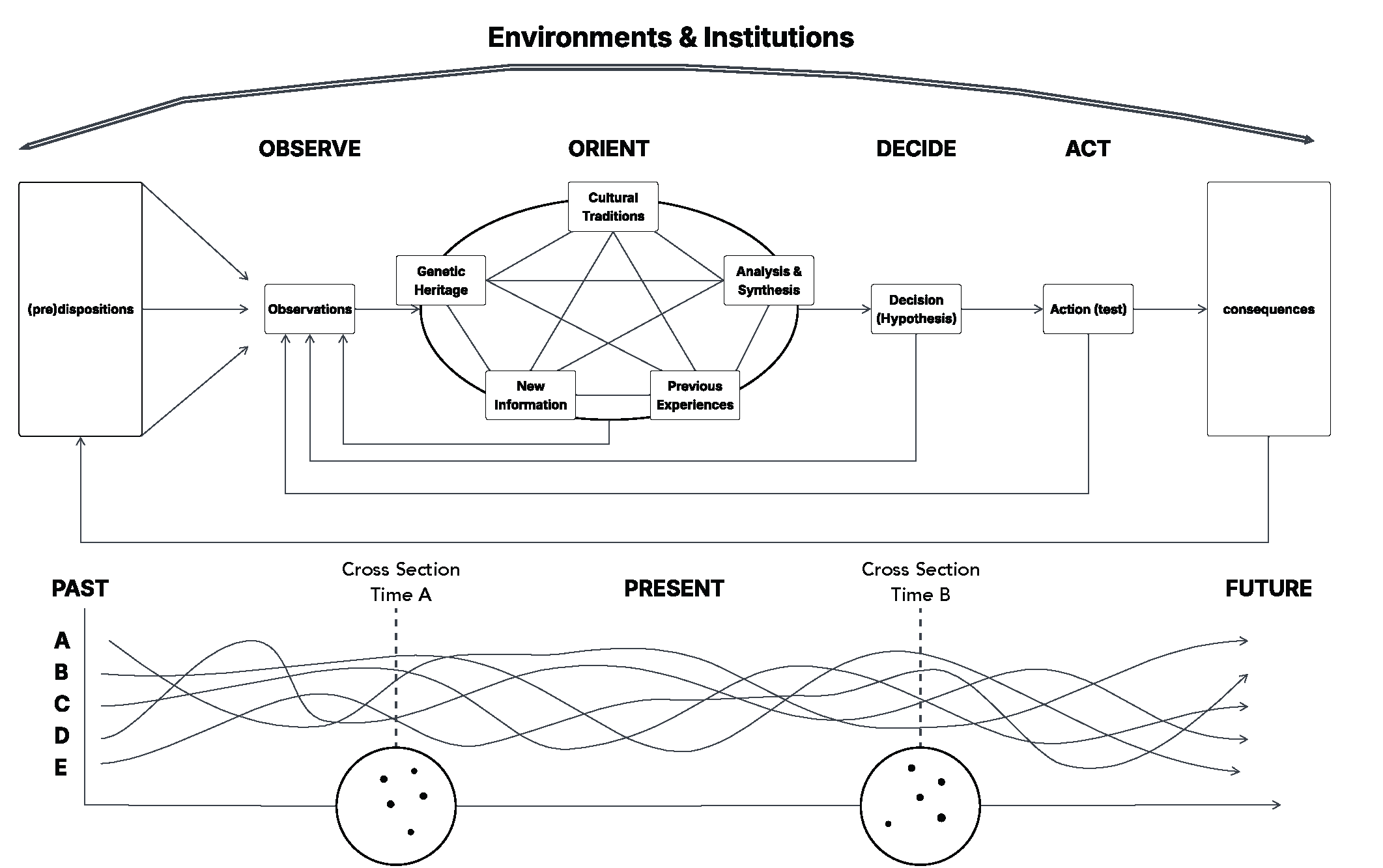
Note. The upper panel situates the dOODAc decision cycle within the broader cognitive ecosystem, in which biopsychosocial dispositions inform the OODA loop and consequences recursively shape future dispositions. The lower panel represents the continuously evolving cognitive environment as a dynamic agent model, within which the cross-sections at Time A and Time B illustrate that, although institutional decision processes remain internally coherent, the operational environment continues to diverge throughout execution.
The implications of this relationship become apparent in the comparison of Time A and Time B shown in Figure 1. Although institutional decision processes remain internally coherent, the operational environment remains subject to a state of dynamicity throughout execution. This divergence reflects the challenge of applying institutional decision processes within an environment that continues to evolve during execution. Operational advantage in the cognitive domain should therefore be understood as a function of the interaction between decision velocity, that is, the speed at which command completes a decision cycle, and the alignment of institutional understanding with the evolving cognitive environments.
As noted above, decisions predicated upon a single, episodic assessment of the operational environment risk misalignment because the environment may have already diverged by the time a decision is executed. Conversely, a deliberately slower decision process intended to preserve alignment with environmental evolution risks inaction, as the temporal window during which the observed environment remains actionable may close before the decision is finalized. From this perspective, a central challenge of cognitive warfare lies in governing the relationship between institutional cognition and an operational environment in which informational, behavioral, and social dynamics evolve continuously and often independently of military decision timelines.
Disclaimer
The views and opinions expressed in this essay are those of the authors and do not necessarily reflect those of the United States government, Department of War, or the National Defense University.
 Mr. John Murray is a Research Intern in the Program for Disruptive Technology and Future Warfare at the Institute for National Strategic Studies at the National Defense University and a graduate candidate in the Master of Public Administration program at Auburn University.
 Dr. Elise Annett is a Research Fellow in the Program for Disruptive Technology and Future Warfare of the Institute for National Strategic Studies at the National Defense University.

Dr. James Giordano is Head of the Center for Strategic Deterrence and Weapons of Mass Destruction Studies of the Institute for National Strategic Studies at the National Defense University and serves as NDU Special Advisor to the Office of the Assistant Secretary of War (CBRN).