Introduction: The Human Brain as Battlespace
Every competitive or conflictive human activity wields some form of power in attempt to affect behavior. Diplomacy seeks to influence it through politics; economic sanctions seek to modify it through the distribution and access of goods; military operations seek to compel it through the threat or use of force; and information operations seek to shape it through exerting influence upon thought, attitudes, values and emotion. In all cases, whether acting upon policy makers, civilian populations, warfighters, and/or their commanders, all such strategic endeavors ultimately engage and operate through the human nervous system. Thus, the brain serves as the mediator of all enterprises of cooperation, competition or conflict.
Cognitive warfare certainly operates in and upon psychological and social dimensions of human action, but differs from historical forms of influence in the increasing ability to understand and exploit the neural substrates and mechanisms that contribute to, if not directly subserve thought, emotion, judgment, and behavior. Contemporary neuroscience provides an iteratively expanding set of intelligence, surveillance and reconnaissance (ISR) data of the biological “terrain and conditions” in which cognitive warfare could be conducted. We opine that the emergence of the brain-as-battlespace can be seen as a significant evolution in tactical nuance and strategic competition, as near future conflicts are likely to be defined and determined by who best employs such ISR to understand and influence the cognitive processes that shape human perception and action.
The Neurobiology of Human Cognition
Neuroscientific studies have demonstrated that cognition occurs through dynamic interactions among distributed, networked systems of the brain, which coordinate activity to continuously integrate internal and external information (for overview, see DiEuliis and Giordano). As schematically depicted in Figure 1, several neural systems are particularly relevant to cognitive warfare. Particularly, the salience network (which involves the anterior insula and anterior cingulate cortex) functions to identify information deemed important for survival and action. The default mode network supports self-referential thought, identity formation, memory integration, and narrative construction. Executive control networks (of the prefrontal cortex) are involved in planning, judgment, behavioral regulation, and decision-making; and limbic structures (e.g., the amygdala, hippocampus, and fornix) contribute to memory consolidation, threat detection, emotional processing, and affective learning, all of which evolved to support adaptive survival.
Figure 1: Diagrammatic representation of major functional networks in the human brain. Note that while defined aggregates of neural nodes and assemblies subtend types of cognitive functions and activities, there is some overlap of different networks’ involvement of brain structures and regions.
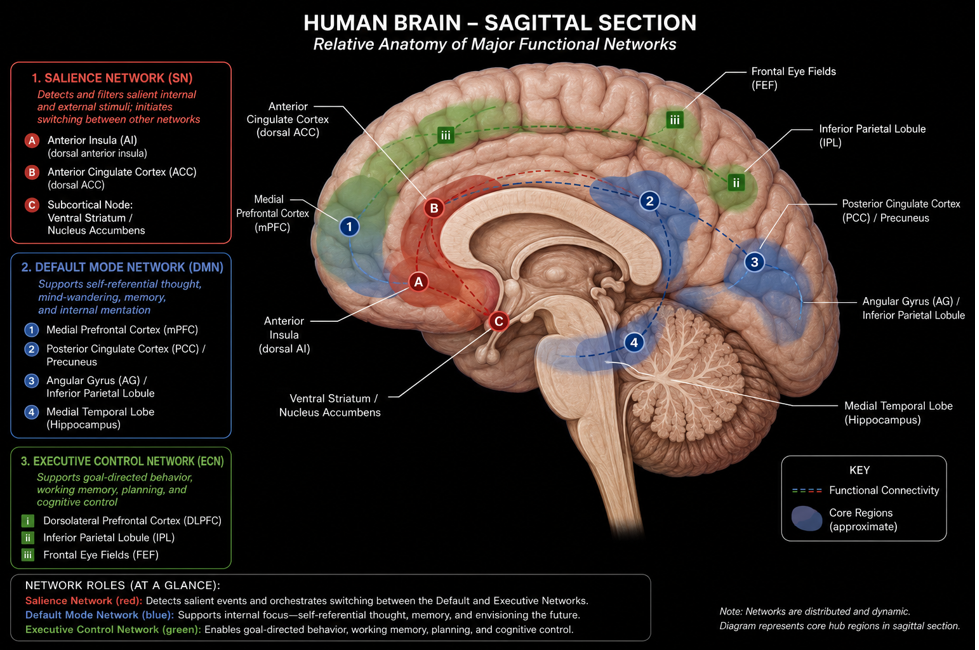
Human cognition relies upon mental heuristics, biases, assumptions, and predictive mechanisms that frequently substitute accuracy for efficiency. These adaptive features can be targeted as exploitable vulnerabilities, and cognitive warfare seeks to identify these substrates and leverage such susceptibilities.
Predictive Brains and Constructed Reality
One of the more influential models in contemporary neuroscience is predictive processing and coding theory, which establishes that the brain functions as an active prediction engine. Accordingly, the brain continuously generates representations of reality and compares incoming information against those expectations such that perception becomes an act of prediction. Thus, individuals actively filter incoming information according to dispositions formed by prior experiences, extant beliefs, emotions, expectations, and sociocultural frameworks. When incoming information confirms dispositional biases and expectations, cognitive “flow” is consonant and perceptions remain stable; when information conflicts with expectations, a condition of cognitive dissonance occurs, and existing schemas of reality must be modified, and/or incoming information (and decision trajectories) must be adapted. This reflects the well-known observation-orientation, decision-action (OODA) loop, and expands the construct to entails prior dispositions and biases, and the interpretive function of consequential effects of behavior (viz., a Biases-Observations-Orientation-Decision-Actions-Consequences (B-OODA-C) loop; see Figure 2). This process is fundamental to understanding cognitive warfare.
Figure 2: Schematic representation of a B-OODA-C loop, as an expanded construct of functional decision-making.

Effect(s) of biases (B) and consequences (C) on patterns of observation (O), orientation (O) contributory to Schematic representation of a B-OODA-C loop, as an expanded construct of functional decision-making neurocognitive processes of decision making (D) and resultant actions (A). neurocognitive processes of decision making (D) and resultant actions (A). Iterative experience(s) establish dispositional cognitions (i.e., biases) against which cognitive engagements of present factors are compared and appraised (via Bayesian dynamics) to influence initiation, extent and type of observation(s) and evaluative orientation(s). Relative valence of orienting processes as relevant to current factors, and reflective of prior value-based (cognitively biased) recollections (casuistically) inform and afford purchase to decisional options (that are weighted against prior experiential cognitions/memories, and their attendant emotional register) to (1) predict possible outcomes of different action effects and trajectories, and (2) compel action selection and execution. The (immediate and latent) consequences of action(s) are cognitively appraised relative to cognitive and emotional valences of prior experiences and actions. Consequences that are aligned with prior biases and expectations are positively reinforced, while those that are not prompt discordance. Additional details in text.
Influence operations succeed because information (positively or negatively) interacts with pre-existing cognitive architectures. Narratives that align with existing beliefs (i.e., which are cognitively consonant) can propagate rapidly. Information that challenges core constructs, values and/or identities (i.e., which are cognitively dissonant) may be rejected regardless of objective accuracy. Thus, successful cognitive engagement depends upon (1) understanding how brains construct reality, and (2) by controlling the information itself.
Neural Mechanisms of Trust, Identity, and Social Cognition
Trust determines whether information is accepted, rejected, amplified, or ignored, and thus one of the most important variables in cognitive warfare. Neuroscientific studies have demonstrated that feelings of trust occur through interactions of the brain’s mechanisms involved in social affiliation, group membership, cooperation, empathy, and collective identity. Humans exhibit strong tendencies toward in-group preference and out-group disfavor, and these tendencies may be amplified during periods of uncertainty, perceived threat, or social instability.
Identity-based narratives, memes and semiotics exert influence because they engage these neural systems, and adversarial cognitive operations can exploit identity dynamics by targeting perceptions of belonging, legitimacy, victimization, grievance, and collective threat. The objective is to alter the social and emotional frameworks through which reality is interpreted, and in this way, affect individual and collective action.
Targeting Neurocognitive Processes
Neurocognitive processes can be targeted indirectly or directly. Most current cognitive warfare activities operate indirectly, by manipulating socio-environmental inputs via information ecosystems (e.g., digital media, social networks, algorithmic recommendation systems, news platforms, entertainment channels, and interpersonal communication) to influence neural processing to affect behavior “downrange.” Emotional content activates attentional systems; threat-related information engages defensive circuitry; social validation or disruption differentially activates reward networks; and narratives shape memory consolidation. With robust and/or repeated exposure, these effects accumulate such that beliefs become reinforced, attitudes become entrenched, and behavioral tendencies can become normalized. This approach is a subtle, yet powerful feature of cognitive engagement, as it exploits natural neurocognitive mechanisms via indirect means that can be difficult to detect and directly attribute.
Although indirect approaches to cognitive warfare are currently predominant, emerging technologies are increasingly enabling more direct assessment and potential modulation of neural activity. For example, advances in multimodal neuroimaging (e.g., convergent use of functional magnetic resonance imaging [fMRI], functional near infrared imaging [fNIR], magnetoencephalography [MEG], high-density quantitative electroencephalography [qEEG]) now afford ability for increasingly detailed observation, analyses and correlation of brain structure and functions. Brain-computer interfaces (BCIs) afford tools for sophisticated communication between neural systems and computational platforms, and neural decoding methods have made it possible to identify brain nodes and networks involved in perception, attention, intention, emotional state, and decision-making that could be targeted and modulated using ever more specific drugs, toxins, microbes, and devices (e.g., directable sonic and/or electromagnetic energy systems). While limitations remain, these developments illustrate a notable trend toward increasing ability to assess, access and affect neurocognitive processes. Tactically and strategically, this affords capability for more diversified, and thus greater means of influence.
Big Data, AI, and Neuroanalytics
The convergence of neuroscience, behavioral science, and computational analytics is transforming understanding and accessibility of human cognition at scale. Historically, neuroscientific research has focused upon individuals, with studies conducted in controlled environments. While valuable, these approaches can be inadequate for understanding how cognitive processes occur and manifest effect in large populations, and/or how collective behavior arises from individual interactions.
However, as we have noted, big data methods and technologies are affording capabilities to accumulate, assimilate, synthesize and analyze a huge amount of vastly different types and levels of information. Artificial intelligence systems can analyze big datasets to identify behavioral patterns, cognitive/emotional tendencies, preferences, vulnerabilities and volatilities, and do so in ways that enable individual-to-group and group-to-individual comparisons and norming. For example, machine learning systems are capable of integrating biological, psychological, social, cultural, economic, and informational variables simultaneously to identify patterns, correlations, and predictive relationships within datasets.
The resulting capability is referred to as population neuroanalytics. Population neuroanalytics enable improved understanding of neural, psychological, and behavioral processes at scale by identifying recurring patterns and relationships between neural mechanisms, psychological tendencies, social interactions, and collective action(s). While totally accurate (viz., “perfect”) prediction remains unrealistic, ever more sophisticated probabilistic models are now achievable.
A next step beyond population neuroanalytics is development of synthetic cognitive modeling. Advances in computational neuroscience, agent-based modeling, machine learning, and digital-twin technologies are feasible for creating virtual representations of individuals, organizations, and populations. Of course, such models do not replicate actual brains, but instead afford simulacra of cognitive and behavioral tendencies based upon known relationships among neural, psychological, sociological, cultural, and environmental variables; the strategic utility of these systems is their ability to evaluate possible futures. Indubitably, all models possess limitations, and human behavior remains inherently complex, adaptive, and often unpredictable. Yet even imperfect predictive capability can afford significant strategic advantage, as synthetic cognitive environments may become indispensable tools for operational planning, deterrence and defense.
To wit, synthetic cognitive modeling can provide valuable capabilities within the cognitive domain, given that such models may enable identification of several factors and functions, as summarized in Table 1.
Table 1: Factors and Functions Viable for Synthetic Cognitive Modeling Approaches
• Emerging social tensions
• Declining institutional trust
• Radicalization pathways
• Information contagion dynamics
• Social fragmentation indicators
• Cognitive resilience factors
• Decision-making vulnerabilities
• Behavioral responses to crises
In effect, the convergent use of big data techniques and tools, and AI enables far more nimble and thus functionally adaptive cognitive engagement, to instantiate a shift from mass persuasion toward precision influence. In this light, near future cognitive operations could be likened to precision-guided weaponry directed against specific targets rather than generalized assault.
However, target specificity does not negate the viability or value of more broadly directed targeting. Indeed, the cognitive condition of populations can be a critical strategic variable and leveraging factor. Historically, the extrapolation of individual data to collective relevance has been difficult, given that no two brains are identical. Individuals differ genetically, developmentally, culturally, socially, and experientially. Moreover, collective behavior emerges through interactions among individuals rather than simple aggregation of individual traits. This complexity has limited attempts to extrapolate directly from neuroscience to population behavior. But the aforementioned scientific and technological developments are reducing, if not overcoming many of these impediments; and thus, the “brain-as-battlespace” of cognitive warfare is poised upon a cusp of capability.
Toward a Doctrine of Neurostrategic Competition: A Research Agenda for the Department of War
Throughout history, military power has depended upon understanding critical domains of engagement and effect. To be sure, the aforementioned convergence of neuroscience, big data, AI, biotechnology, and information technology creates a new engagement environment that we believe could be regarded as the milieu of neurocognitive strategic competition. Currently, states that successfully integrate these disciplines could acquire unprecedented capabilities to understand and shape human thought and behavior. The implications extend beyond military operations. Political stability, economic confidence, social cohesion, and national resilience all depend upon such cognitive factors.
Accordingly, we argue that cognitive security must become a central component of national security. To remain apace of, if not preferably ahead of peer-competitors’ and adversarial developments, we advocate that the DoW should establish an interdisciplinary and operationally focused Cognitive Security and Neurostrategic Research Enterprise. Toward such an enterprise, the following lines of effort are proposed:
1. Development of a national cognitive security assessment program, to develop methods and improved tools to assess cognitive vulnerabilities and resilience across military forces, governmental institutions, and critical populations.
2. Support for programs in population neuroanalytics, toward advancing understanding of relationships among neural architectures and mechanisms, cognitive processes, behavioral dynamics, social cohesion, and strategic stability.
3. Fortification of AI-enabled strategic sentiment mapping to create systems capable of monitoring evolving cognitive and emotional trends that are relevant to national security.
4. Establishment of formal programs of human-AI cognitive teaming to develop technologies that enhance decision-making while preserving human judgment and ethical oversight.
5. Development of education and training in cognitive resilience aimed at identifying methods to strengthen resistance against manipulation, misinformation, coercion, and adversarial influence.
6. Increased capability and engagement of adversarial neurotechnology intelligence efforts to monitor global developments in neuroscience, neurotechnology, AI-enabled behavioral systems, and related dual-use capabilities.
7. Establishment of metrics, standards and programs in cognitive effects assessment to develop rigorous methodologies for measuring cognitive effects and evaluating operational outcomes.
8. Focused address of neuroethical and legal governance to establish frameworks ensuring responsible development and use of cognitive-security capabilities.
Recommendations
Toward achieving these ends, we offer the following recommendations:
1. Establish a Joint Cognitive Security and Neurostrategic Center
The DoW should establish a permanent cross-functional organization integrating expertise from neuroscience, behavioral science, biotechnology, AI, strategic deterrence, and military planning.
2. Create a National Neurotechnology Intelligence Program
A dedicated intelligence effort should continuously monitor foreign developments in neurotechnology, computational neuroscience, cognitive warfare, AI-enabled behavioral analytics, and related dual-use capabilities. Particular attention should focus upon activities conducted by China, Russia, Iran, and North Korea.
3. Develop a Cognitive Security Data Architecture
The Department should establish secure infrastructures capable of integrating behavioral, informational, sociological, and neurocognitive datasets while maintaining appropriate legal and ethical safeguards. Such architectures will be essential for future cognitive-security operations and analyses.
4. Launch a Cognitive Resilience Initiative
Training, education, leader development, and force-preparation programs should incorporate cognitive-security principles. The objective should be development of cognitively resilient personnel, organizations, and populations capable of recognizing and resisting adversarial influence efforts.
5. Establish a Ten-Year Neurostrategic Research Portfolio
Long-term investment is required. Short funding cycles are insufficient for sustained advancement in neuroscience and technology, big data, and AI. A dedicated research portfolio should be established comparable to historical investments in nuclear deterrence, cyber security, and biodefense.
Conclusion
The future of strategic competition will be defined and determined by the ability to understand, influence, protect, and defend the human cognitive processes that shape perception, judgment, decision-making, and behavior. Advances in neuroscience are revealing the neural substrates that are involved in and subserve thought, emotion, and action. Concomitant advances in big data and AI are enabling unprecedented capacity to examine relationships between individual cognition and collective behavior.
Taken together, these developments have established cognition as a domain of tactical accessibility, strategic relevance and operational viability and value. Adversaries recognize this reality and are actively pursuing capabilities designed to exploit cognitive vulnerabilities, manipulate perceptions, degrade trust, and influence thought, emotion and behavior. The U.S. cannot afford to regard such developments as merely academic or theoretical but instead should acknowledge and respond to such advancements as emerging risks and threats to national security. Thus, the challenge and opportunity for DoW is to strengthen the scientific, technological, operational, and ethical foundations necessary to successfully secure and protect the neurocognitive domain.
Indubitably, success of an enterprise of this magnitude will necessitate sustained investment, interdisciplinary collaboration, strategic foresight, and whole-of-nation commitment. As previous generations developed doctrines for nuclear deterrence, and biological and chemical weapons governance and control, we opine that it is now vital to develop a coherent doctrine of cognitive security and neurostrategic competition. For in this emerging environment, strategic advantage will increasingly belong to those who most effectively understand and protect the biological, psychological and social dimensions that influence human thought, emotion, judgment, and action.
Disclaimer
The views and opinions expressed in this essay are those of the authors and do not necessarily reflect those of the United States government, Department of War, or the National Defense University.

Dr. James Giordano is Head of the Center for Strategic Deterrence and Study of Weapons of Mass Destruction, and Program Lead for Disruptive Technology and Future Warfare of the Institute for National Strategic Studies at the National Defense University. He is also Professor Emeritus of Neurology, Biochemistry, and Ethics at Georgetown University Medical Center.
 Dr. Robert Schmidle (LtGen, USMC, ret) is a Professor of Professional Practice in the Irregular Warfare Center at the Arizona State University.