The recently released NATO Chief Scientist’s 2025 Report on Cognitive Warfare provides a timely acknowledgment of a strategic reality that contemporary conflict is increasingly behavior-centric, and the decisive terrain is often not geographic but how individuals and groups perceive, interpret, decide, and act. I have had the privilege, honor and pleasure of working on NATO’s initial cognitive warfare studies beginning in 2018, which explicitly emphasized that cognitive warfare is not merely “PSYOPS with better tools.”
Indeed, NATO efforts in this space echo our group’s ongoing work that has argued for a more expansive, yet nonetheless realistic view of cognitive warfare as a mix of emerging technologies, influence methods, and adversary exploitation of societal fault lines that can be engaged to shape the conditions under which humans form beliefs, allocate attention, and generate intent. The nature of warfare may remain the same, but operationally I posit that cognitive engagements change three fundamentals of military missions, namely:
• The target set expands from discrete platforms or messages to human cognitive and social systems (trust networks, identity narratives, institutional legitimacy).
• The battlespace becomes continuous, operating non-kinetically below thresholds of armed conflict, blending strategic competition, hybrid pressure, and wartime maneuvering.
• The measure of effectiveness shifts from short-term message penetration to durable changes in cognitive patterns and behavioral dispositions (e.g., risk perception, threat appraisal, civic cohesion, and willingness to support military action).
Increasingly, neurotechnology and artificial intelligence (AI) are becoming dual-use instruments for cognitive engagement to leverage biological, psychological, and social levels of effect, as follows:
Biological Level: Manipulating Capacity
This level directly targets the nervous system as the focal substrate of thought, emotion and behavior. Neuroscientific techniques and technologies (neuroS/T) can be used to assess and affect individual (and aggregate/group) physiological functions to alter (i.e., disrupt, direct, degrade or improve) cognitive capabilities, mental states, decision-making and actions.
Psychological Level: Manipulating Interpretation
Here, the focus is upon influencing cognitive appraisal(s), framing, emotions, and the patterns of thought that contribute to and shape individual and collective attitudes, beliefs and judgment. AI-enabled influence (for example, on social and public media) can tailor stimuli to engage individual and group vulnerabilities and volatilities (which may have been previously or co-modulated through the use of neuroS/T to affect susceptibility by altering arousal states or attentional gating).
Social Level: Manipulating Cohesion
This is the over-arching level for influencing shared narratives, beliefs, institutional legitimacy, and public views, values and activities. Cognitive engagement seeks to fracture cohesion, weaponize identity, and create epistemic chaos. In this light, NATO’s emphasis that the cognitive front is not only military but societal is both accurate and strategically important to recognize.
In practice, these levels are not mutually exclusive, but rather can and should be regarded as complementary, reinforcing domains and dimensions of vulnerability, influence, and targetability; utilizing bottom-up (biological targeting to incur psychological and social effects), middle-out (i.e., psychological targeting to evoke both biological responses and social manifestations), and top-down (i.e., social level engagement(s) to induce both psycho-biologic and bio-psychological effects) approaches (as shown in the figure below).
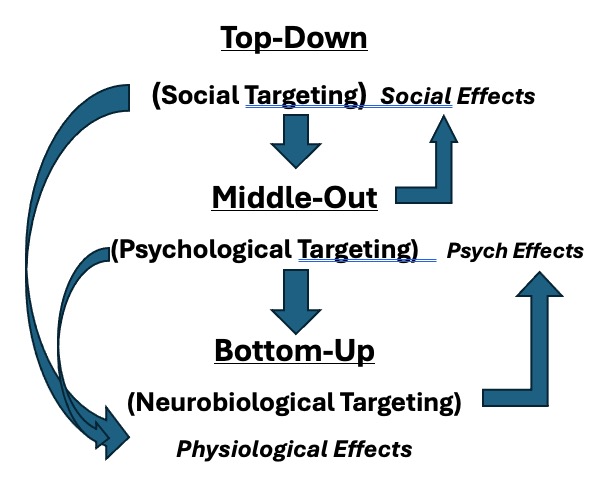
NATO’s cognitive warfare ecosystem is explicit in its call for building practical capability and developing doctrine for operating within it to (1) acknowledge these bio-psychosocial levels and factors of effect, and (2) formulate paradigms for developing more accurate detection, fortified resilience, and directed deterrence and defense. This speaks to the need to appreciate cognitive warfare on a broader scale, and as executable in and across global theatres of operations.
The military relevance of such cognitive engagement capabilities is twofold. Offensively, neurotechnologic and AI-enabled tools can be employed to influence adversary decision cycles through disruption of sensemaking, misdirection of confidence, and steered direction of group-level dynamics. Defensively, cognitive engagement can be leveraged to safeguard force readiness and fortify societal resilience against manipulations that seek to disrupt individual and/or collective capabilities through narrative exploitation, stress induction, attentional saturation, demoralization, and/or engineered distrust.
Convergence: AI as Accelerant of Cognitive Engagement
Cognitive warfare extends into the social substrates of trust, shared epistemic standards, and institutional legitimacy. From a force-development standpoint, AI becomes both threat and countermeasure: the same methods that enable adversary influence can (under current rule-of-law constraints) be employed to support defensive cognitive security (e.g., anomaly detection in influence networks; pattern recognition for coordinated inauthentic behavior; and decision-support for commanders managing narrative risk). Thus, if neuroscience and technologies are the means of “influencing the mind by affecting the brain,” AI is increasingly becoming the means by which to "affect the mind by manipulating the information ecology." Hence, the operational concern is not simply that AI can generate persuasive content, but rather, that AI can be used to:
• Micro-segment populations to enable psychographic and behavioral targeting
• Optimize narratives in real time and across channels
• Automate social amplification (e.g., using bot/hybrid actor swarms)
• Create synthetic credibility (e.g., deepfakes, synthetic experts, forged “evidence”)
• Exploit cognitive biases, values and vulnerabilities (e.g., salience, fear conditioning, in-group/out-group polarization).
…and do so with speed and target-specification on a variety of scales. Thus, the NATO report should be used as a sentinel call to look beyond the European theatre, identify which actors on the global stage possess these capabilities, examine their current programs, projects and potential applications, and acknowledge the clear and present realties of their using extant and emerging S/T in cognitive warfare engagements.
Recommendations
Given these realities, if NATO’s 2025 Chief Scientist agenda is to be more than an important conceptual marker for the field, I believe it should drive military capability projects that align with how cognitive effects are generated and can be defended against in the current milieu of global power competition. Toward such ends I propose the following recommendations:
1. Develop cognitive indicators and warnings as a standing function, to include enduring fusion cells that integrate neurocognitive and behavioral science, data and cyberscience and technology, and operational intelligence.
2. Instantiate neuro-AI readiness and resilience programs for the force, which entail training, assessment, and protective measures that regard cognition as a mission-critical substrate, and not merely a "soft" add-on.
3. Establish doctrine for cognitive engagement in military domains of operation. Cognitive effects should be integrated into planning alongside cyber, electronic warfare. space, and information activities, given that cognitive outcomes frequently determine whether kinetic engagement becomes tactically effective and strategically successful.
4. Expand ethical-legal frameworks for governance of dual-use neuroS/T and AI. Military forces must operationalize “responsible use” approaches, particularly given that cognitive engagement tools blur traditional lines between persuasion, manipulation, and coercion. This is where prior NATO work on mitigating and responding to cognitive warfare remains relevant; defense surely demands the use of cutting edged science and technology, but equally necessitates guardrails for guidance, governance and response.
Conclusion: Cognitive Superiority is Not Optional
The NATO report rightly recognizes that the international contest for power advantage is increasingly being engaged through human cognition, collective sensemaking, and societal effect. The convergence of neuroS/T and AI will intensify this reality by enabling precision influence at scale through biological, psychological and socially mediated modulation of human cognition, emotion, behavior and vulnerability.
Therefore, I opine that the critical point to be taken from the NATO Chief Scientist’s Report on Cognitive Warfare is that the task at hand is to ensure that initiatives in cognitive engagement become operational capabilities; with measurable indicators, trained forces, partnered resilience, and governance of dual-use S/T in an era where the “battle for the brain” is no longer a metaphor, but becomes a factor in defense planning on the world stage.
Citations
Giordano J, Forsythe C, Olds J. Neuroscience, neurotechnology and national security: The need for preparedness and an ethics of responsible action. AJOB-Neurosci 1(2): 1-3 (2010).
Giordano J, Wurzman R. Neurotechnology as weapons in national intelligence and defense. Synesis: A Journal of Science, Technology, Ethics and Policy 2: 138-151 (2011).
Giordano J. The neuroweapons threat. Bull Atomic Sci 72(3): 1-4 (2016).
DeFranco JP, DiEuliis D, Giordano J. Redefining neuroweapons: Emerging capabilities in neuroscience and neurotechnology. PRISM 8(3): 48-63 (2019).
Giordano J. Chem-bio, data and cyberscience and technology in deterrence operations. HDIAC J 8(1): 26-35 (2024).
Disclaimer
The views and opinions expressed in this essay are those of the authors and do not necessarily reflect those of the United States government, Department of War or the National Defense University.

Dr. James Giordano is Director of the Center for Disruptive Technology and Future Warfare of the Institute for National Strategic Studies at the National Defense University.